Pages

Showing posts with label Florida. Show all posts

Tuesday, June 17, 2014

One More Shot

I was staring at the water, trying with all my power to make a tarpon appear.  There was a breeze, but it was not offensive to our casting; it did however compromise our visibility.  Our guide had us positioned so that the wind came from the stern and our shots would be anywhere from 9 to 2 o'clock.  The chop and afternoon glare made spotting fish tough, but we did our best, often seeing the fish a little later than we would've liked.  It was getting late in the day and though no one had said it aloud, our time was getting short.  "One more shot," I thought to myself over and over, even after I missed one.  "Just give me one more shot."
 
It was Saturday, May 24th, the afternoon of my fifth straight day of tarpon fishing.  The month had been very difficult for fly anglers in the Keys.  A group of two anglers from work had been skunked two weeks prior, and another angler from work had been blanked the week after that.  It had been blowing like hell for most of the month, but had layed down the past few days.  Finding fish or getting shots weren't the problems; making the fish eat was.  I was with three other anglers, all talented and our stats for the week were miniscule:  seven eats between four anglers in five fishing days.  Ouch. 
 
Finally the dreaded order from the stern came:  "OK, let's reel it in."  I began false casting to clear the line, all the while looking around for one more shot.  I began to accept the fact that I had been skunked after five days of fishing and that I wouldn't have another shot at a tarpon for nearly a year.  I looked at the water, the sky and the mangroves and tried to soak as much of it in as quickly as possible.  The boat was quiet as we all processed another fishless day and began preparing to run back to the boat launch.  Then at 100 or so feet a tarpon rolled.  We all swung our heads and stared.  We saw fins, many of them.  "Hold on, get ready!" the guide yelled as he got back on the poling platform and began pushing us toward the fish.
 
At first it looked like they were cruising at us, but as we got closer we saw the school was somewhat chaotic, not cruising nor chained up.  We watched.  In a matter of seconds the school gained order and began daisy chaining.  There were around 20 of them, all following each other, around and around the went.  They were swimming clockwise so my first shot was on the right side of the chain.  No response.  Same cast, same result.  I was then instructed to cast inside the chain, laying only my leader over the fish going right-to-left in front of me, targeting the fish coming at me on the right side of the chain.  One cast, no response.  What happened next occurred over perhaps a few seconds, if that.
 
I put a cast down inside the chain, the fly landing just to the left of the fish on the right side of the chain.  I began pulling the fly away from them.  One fish then broke away from the chain and made a move on the fly.  It came up from below, and I looked down the mighty fish's throat as it opened wide to engulf my fly.  This happened twenty five feet in front of me.  I stripped to set the hook and stung the fish but the hook did not sink.  In hindsight, I certainly set too soon, pulling the fly out of the fish's mouth.  The fish was stung though and blew up instantly.  The rest of the school did the same.  I watched as the school fled and the water settled.  I then turned around to look at my boat mates.  We were all smiling in disbelief.  "Did that just happen?" I asked.  "I think so," one said. 


Monday, March 31, 2014

Shooters Shoot

Before my good friend Andy Lee relocated to Chokoloskee, a small island on the northwest border of Everglades National Park, I had never heard of it.  Now after three visits, it's a place that is familiar and holds a place in my heart.  That the lovely Lee family calls the island home makes it even feel a bit like that to me as well.  Each trip has been longer than the previous one.  That fact may say enough about the fishery.  I have just returned from six days fishing in the 'Glades with Andy and my Old Man.  What a time we had. 

Dawn on Chokoloskee island, where you "have to go north to get to The South."
The saltwater sight-fishing game is an exciting one, for lack of a better adjective.  Just getting yourself a good shot at a fish can be the hardest part of the equation.  Weather is a strong variable.  In the perfect scenario, the fish are in en masse, you find them easily and you get lots of good shots.  In the more frequent, less-than-perfect scenario, shots don't come easy and when they come, they're not ideal.

Before my first tarpon trip several years ago, I loaned a 10-weight from a friend and practiced by double hauling and shooting as much line as I possibly could, thinking that the shots would be far away and distance was the primary objective.  This is far from the case when actually on the water; the vast majority of shots are in the 40' range, with many even as close as 10'.  Dropping a 2/0 tarpon fly on a dime at 15' is a lot harder than I ever imagined.  Add in wind, rough seas, moving fish, a moving boat, a 12' leader and you can begin to understand the situation.
Sunrise in the 'Glades.
To be successful, you've got to make your shots count.  You never know when the next one will come and you've got to be ready.  Sometimes the shots are numerous but other times, you can go hours between.  It's easy (and probably good) to forget about the last shot you blew when you're faced with the next one, but when the day, and the trip, is over, all the missed shots come back to mind and then you can lament over the ones you blew.  There were certainly enough of these to reflect upon after this trip's end.  Fortunately, we didn't blow them all.
Creekin'.  The maze of creeks in the Everglades is astounding.  Many lead to fishable bays. 


At the ready, looking for the next shot. 
Shoot.
Keep shooting.
Tarpon were at the top of our list this trip and can be found in several general ways in the 'Glades:  there are "swimmers," cruising fish that need to be intercepted, "rollers," fish that break the surface then sink back down and lastly, "floaters," or laid-up fish, stationary and fairly high in the water column, allowing them to be seen and fished to.  The floaters are by far the most exhilarating, as the entire shot is visual and you can watch the fish react to your fly.  Depending on conditions, the floaters can be hard to find, if at all.  When the case, you need to find the fish somehow, so the rollers become more likely targets.  After these fish break the surface, they'll sink out of sight, but thankfully they release some air as they do, and these air bubbles come to the surface, giving the angler a fairly good idea of where the fish has gone.  From there, you need to drop your fly in the bubbles, let it sink and hope that the fish is still there and sees the fly.  It's certainly not a guarantee, but it's about the best you can do.  

On the morning of our first day on the water, Andy took us to a small bay and we immediately started seeing rollers as we poled our way deeper into the bay.  I was first on the stick that day and very quickly found myself about to take my first shot at a tarpon in a year.  The fish rolled, sank and the bubbles came up.  I dropped my fly in the middle of them, let it sink then started my retrieve.  A few seconds later and it came tight.  

 We were on the board.
Swish.
After blowing the rest of our shots that day, some weather rolled in that we were forced to deal with.  This essentially shut the tarpon fishing down for the next two days.  Fortunately there are other species to be reckoned with in the Everglades and we turned our attention to the wily snook that lurk amongst the mangroves.  You can sight fish for snook when conditions are optimum, but there is also a lot of blind fishing involved, poling 30 - 50' from the bank, pitching flies under overhanging limbs, into creek mouths, around down trees and any structure you find.  It's a fun game to play, certainly a casting workout and flies often find themselves landing in the mangroves.  We had some good topwater fishing and caught a good number of small to medium sized snook.  But tarpon remained in the back of our minds.

On our forth day, the weather had returned to conditions allowing for us to tarpon fish.  It wasn't perfect, but we did what we could, poling into the wind across big bays, looking for floaters and rollers.  It was a tough day and we did our best, which turned out to be not good enough, save for one fish.  The shots were in close range that day and they came and went in an instant.  We got one though.  Seeing a 100-pound tarpon jump 20 feet away is an image I hope never leaves my mind.
The last two days were spent in exploratory/R&D mode, scouting new spots and playing around with some new toys.  We covered a lot of ground in those final days, but did manage to find a few more fish.  Andy scored on a roller in one new bay and I jumped another fish that looked exactly like a dolphin when I saw it roll.  Andy was in hysterics as I casted at what I was sure was not a tarpon.  Then I saw a silver flash under the surface the size of a dinner table and the water exploded as the fish cleared the water.  It would soon spit the fly, leaving me wondering what had just happened and thinking about the next chance I'll have at the Silver King.  

For 2!
One afternoon, while running a creek from one bay to the next, a pair of birds whose names I can't remember spooked and started flying in front of the boat.  We would end up chasing them up the creek for what seemed like miles, them not leaving the creek's path.  They were just like those northern Maine moose that won't leave a logging road when you're behind them in your pickup.  We got a chuckle out of that one.

So we ended the trip with three tarpon to the boat, another one jumped, a handful of nice snook, a couple redfish in the mix, and a burning desire to get back and shoot some more.
Dale Moon even made an appearance.  
Until next time...

Friday, April 5, 2013

Tar-PON

On the western edge of Everglades National Park there's an island community nestled amongst the mangroves.  A local once told me that it's the only place where "you have go to north to get to The South."  Chokoloskee and Everglades City are unique, quirky and warm communities and the natural treasures they hold the key to are worth the journey.
 
I made my second (hopefully annual) trip to Chokoloskee last month and once again met up with "Boss," that's Andy of Grassroots Guiding.  Word was that the tarpon had showed up, but the weather had been all over the place over the course of March.  The old man and I had three days on the water to come, so we'd give 'em hell while we could.


Tarpon fishing is, challenging, among other things.  Like any challenging sight-fishery, a lot of things have to happen before you can find, hook, and land one.  Water temperatures, air temperatures, sun, clouds, wind, tides, and availability of a boat and/or guide are factors that need to go right before you can even find a laid-up tarpon in the Everglades.  Fly choice, fly presentation, fly depth, casting accuracy, casting delicacy and a happy fish are all factors that need to be right before you can hook one.  A solid strip-set, a hook that holds, knots that hold, enough backing, a rod and reel with enough nuts, a fish that doesn't jump or roll on your leader and someone to get a hold of the fish are all things that need to happen to get that grip and grin photo.  Most of the time, one of the many things above doesn't happen or go right.  But sometimes they all do. 


And when they do, it sure is fun!
 
 
Other helpful additions to a day of tarpon fishing include fresh-baked cookies and a guide that will do his praying mantis dance on the platform.

 
Get serious, Boss, would'ya?  You just blew out two.


Thursday, November 8, 2012

Videos From Friends

Lotsa action on SH lately!  I'll continue by adding a few edits from a couple friends.  Enjoy!

Some Everglades action from Andy and crew at Grassroots Guiding:


Everglades Fly Fishing from Andy Lee on Vimeo.

The first video installment from Nick & Zach down in South America:

Sunday, June 24, 2012

Grassroots Guiding: Beneath the Mangroves

 My man Andy has got his guide service website up and running.  Check him out here.  Anyone interested in epic Florida backcountry fly fishing in the Everglades, get in touch.


Tuesday, June 5, 2012

Keys to success

Arrive in Florida Keys.
Get your motor running.
Find them.
Cast to them.
 Feed them.
 Jump them.
 Fight them.


Hope it all goes well.

Wednesday, April 11, 2012

The Florida Keys...


A dozen gin and tonics and a 150 plus pound tarpon off the dock and you've got your own little slice of paradise... Oh yea.

Wednesday, February 29, 2012

Beneath the Mangroves

After several months of phone call conversations and planning, I was very fortunate to spend the last four days fishing with my good friend and former Head Guide Andy Lee of Grassroots Guides, Beneath the Mangroves. Andy recently relocated to Chokoloskee, Florida, where he has been fishing the Everglades backcountry for redfish, snook, and most recently, tarpon. We had quite a trip.
Andy runs a 18' Hell's Bay and it's the perfect rig for fishing the backcountry flats, weaving through the creeks and poling across the big bays of the Everglades.
We spend the first three days sight fishing to reds and snook. The redfish were a little easier to see: more out in the open, along vegetated flats or among oyster beds. The snook were trickier business, as we poled countless banks trying to spot these fish lying in ambush beneath the mangroves.
We had a good number of shots for snook, but they are a wiley fish. Many times we would see one and before we could drop a cast in front of it, the fish had retreated to cover beneath the trees. We would often pole by a fishy looking spot, unable to see a fish only to see the fish bolt from underneath us or the trees to explode as the fish took off. When we did see one and get a good cast in front of it, the fish would either immediately bolt or destroy the fly. We had some great takes and were able to land a few.
We also found a good number of redfish. A little easier to see, but often just as fickle, we brought a few of these to the boat as well. Enticing the reds to strike was a little more sensitive as we teased them to strike by pulling flies away and then letting them catch up. A great game to play.
At some point during our third second or third day we started seeing some black drum cruising amongst the reds. A fast sinking crab pattern was the trick for these odd looking fellars.
We had a slightly nervous moment as we noticed a gator approaching while Paul landed one particular drum. Andy made us second guess ourselves when he joked that gators always travel in pairs, one under the surface.
For our last day on the water, we fished for reds in the morning and then decided it was time to try and see some tarpon. We were surprised and instantly excited as we poled down our first bay and a heron spooked one and then we started seeing tails and wakes.

I was first up and had a good shot at a happy fish about a foot under the surface. I made two casts and on the second had an eat, but it didn't stick. We were pumped though as our first good shot resulted in a take. On we went.

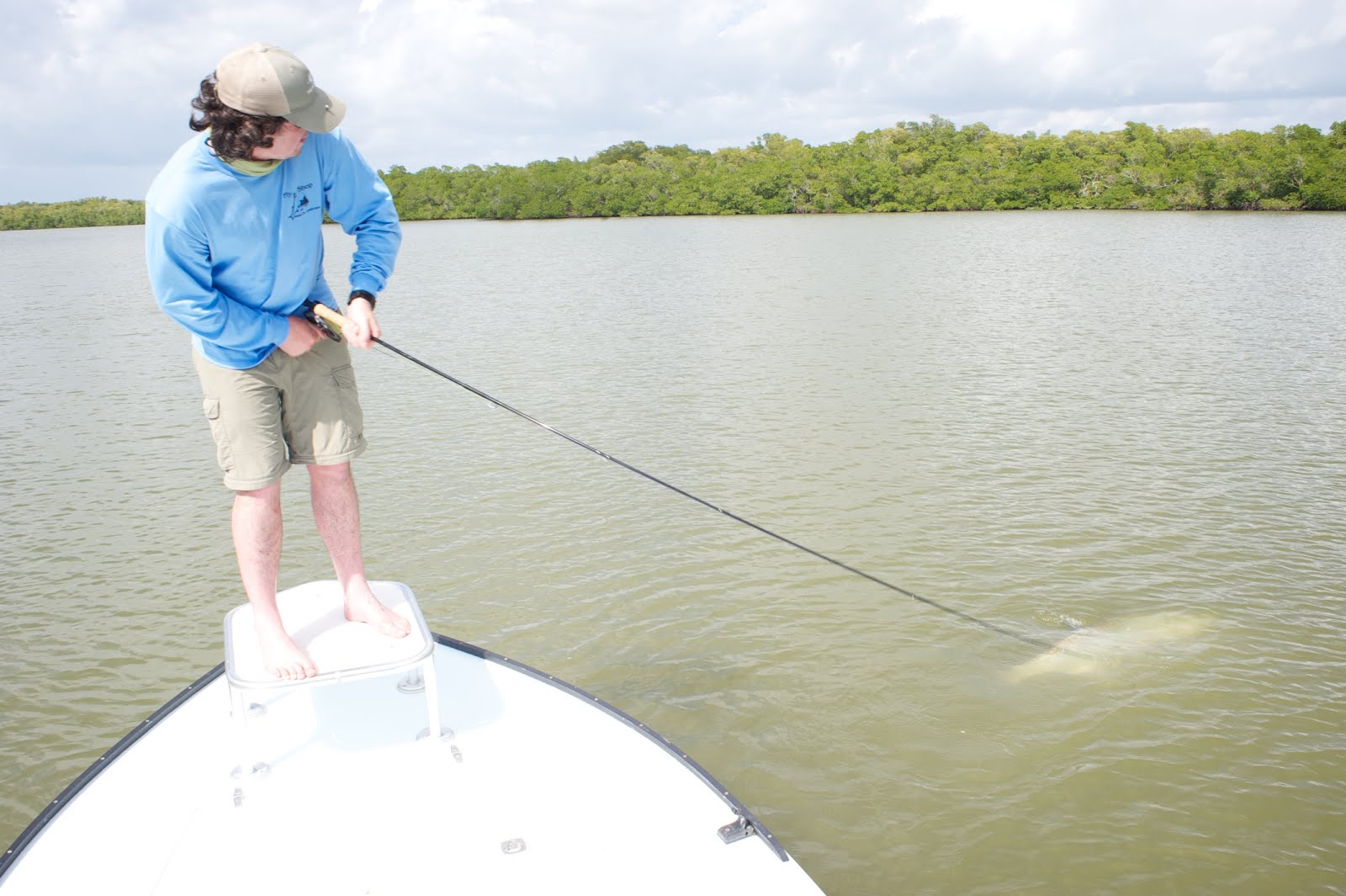
Paul took some shots at some fish to no avail and then it was my turn on the bow again. The fish were hard to see given the muddy, murky water of the everglades but we soon found ourselves right upon a very large shadow under the surface. Wind at the moment almost blew us over the fish, but Andy circled us around to where I could take some good shots. My first four casts were no good, but on the last, it looked as though the fish was interested. I was lucky the fish hadn't bolted. I took another cast and this one was on the money, a few inches in front of the fish. Not even six inches into my retrive and the water exploded, the fish coming out of the water to crush the fly, a tan, deer-hair head slider. And then it was on. Into the backing within seconds, leaping in the distance, the line cleared and I remained tight. It was looking good.

I had some good shots at tarpon last spring but wasn't able to coax any to eat. We joked later that this fish chose me, allowing for my first nervous casts to pass until I put the fly where he wanted it.
The fight lasted about 40 minutes, the last 30 or so within 30 feet of the boat, the hardest part of the whole ordeal.
Finally the fish rolled over and with a hand on its lip, the fish boatside, Andy grabbed the leader and it gave. Away the fish went. High fives and laughs filled the boat as we recounted the battle and charted the boat's course as the leviathan towed us around the bay.

It would be our last fish of the day and of the trip, a perfect way to go out. It didn't take long before we started scheming our return. An easy, two and a half hour drive from Miami International Airport, I recommend anyone looking to get into some Everglades tarpon action get in touch with Andy, and hang on for the ride.